Information only, not medical advice.
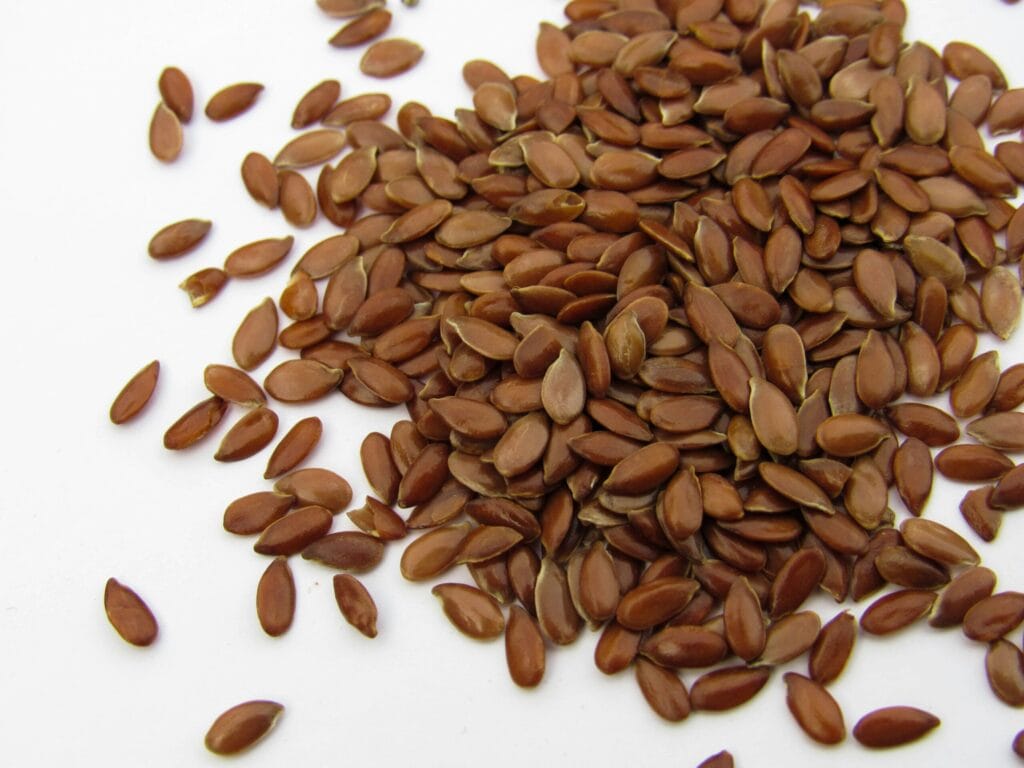
You’ve probably sprinkled whole flaxseed onto oatmeal or into a smoothie at some point, following advice to add “more omega-3s and lignans” to your diet. Here’s what most of that advice leaves out: if the seeds went in whole, a meaningful share of them likely came back out the same way they went in — intact, undigested, and nutritionally almost inert.
Why doesn’t whole flaxseed work?
Because the shell is built to survive digestion. A flaxseed has three parts: a tough outer coat, an oil-rich interior, and a small embryo. That outer coat is durable enough to survive 24 hours submerged in water without breaking down — it evolved to protect the seed until conditions are right for germination, not to dissolve conveniently in the few hours food spends in your gut.
The problem is that everything valuable about flaxseed — the alpha-linolenic acid (the plant-based omega-3), the lignans, most of the protein and minerals — sits inside that shell. Your digestive enzymes generally can’t get through it in the time available. Chewing helps, but most people don’t chew seeds thoroughly enough to crack every one, especially stirred into a smoothie and swallowed in a few gulps.
What does the research actually show?
Whole flaxseed delivers only about a third of the lignans your body can actually absorb from ground. This isn’t theoretical: a randomized crossover study had 12 healthy adults eat measured amounts of whole, crushed, or ground flaxseed on separate occasions, then measured how much of the seed’s lignans actually reached their blood. Whole flaxseed delivered just 28% of the lignan availability that ground did. Crushed — roughly cracked, not fully milled — did better at 43%, but still fell well short of properly ground.
In practical terms: if you’ve been eating whole flaxseed for the lignans, you’ve likely been getting less than a third of what you thought. Not a rounding error — the majority of the intended benefit, gone before it ever reached your bloodstream.
Why do lignans matter, especially after 40?
Lignans are plant compounds that behave like weak phytoestrogens — they can bind gently to estrogen receptors and exert a mild, modulating effect, which is why flaxseed comes up so often in conversations about the hormonal shifts of your forties and fifties. Flaxseed is one of the richest dietary sources of lignans by a wide margin. If that’s why you added it to your routine, the grinding step isn’t a technicality — it’s the difference between a food that’s doing something and one that’s mostly passing through. (To be clear: this is a gentle dietary effect, not a treatment for any symptom.)
What about the fiber — does grinding matter there too?
Here the whole seed holds up fine. Flaxseed’s fiber — both soluble and insoluble — does its bulk-forming job whether the seed is whole or ground, because that effect doesn’t require cracking the cell walls the way lignan absorption does. So if regularity and gut health are why flax is on your radar, whole seeds were quietly working all along. It’s specifically the lignan and omega-3 goal that the shell was defeating. If gut health is the bigger picture for you, what gut-lining repair actually takes covers adjacent ground.
How to fix it (about thirty seconds)
You don’t need a special product. A basic coffee grinder or small food processor turns whole flaxseed into meal in a few pulses. The one tradeoff is storage: whole flaxseed keeps up to ten months in a cool, dry cupboard because the intact shell protects the oils from oxidizing. Ground flax loses that protection the moment you grind it, so it goes rancid faster — keep it refrigerated or frozen, airtight, and use it within a couple of months.
A sensible middle path: buy whole, grind a week’s worth at a time, freeze what you’re not using immediately. You get the shelf-stability of whole seeds most of the time and the absorption of ground when it counts.
Want to read the research yourself?
- Milling and crushing flaxseed raises lignan bioavailability (the 28% vs 43% crossover study) — Journal of Nutrition (2005)
- Lignans: dietary sources and what they do — Linus Pauling Institute, Oregon State University
The next time you reach for the flaxseed bag, grind it first. It’s a thirty-second habit that turns a tablespoon from something that mostly passes through you into something your body can actually use — and now you know exactly why the step matters, instead of just being told it does.
If you added flaxseed because something felt off in midlife — the energy, the shifts you couldn’t quite name — it helps to see the whole pattern, not chase one fix at a time. The free Energy Audit walks you through the five patterns of midlife fatigue so you can start where it actually counts.