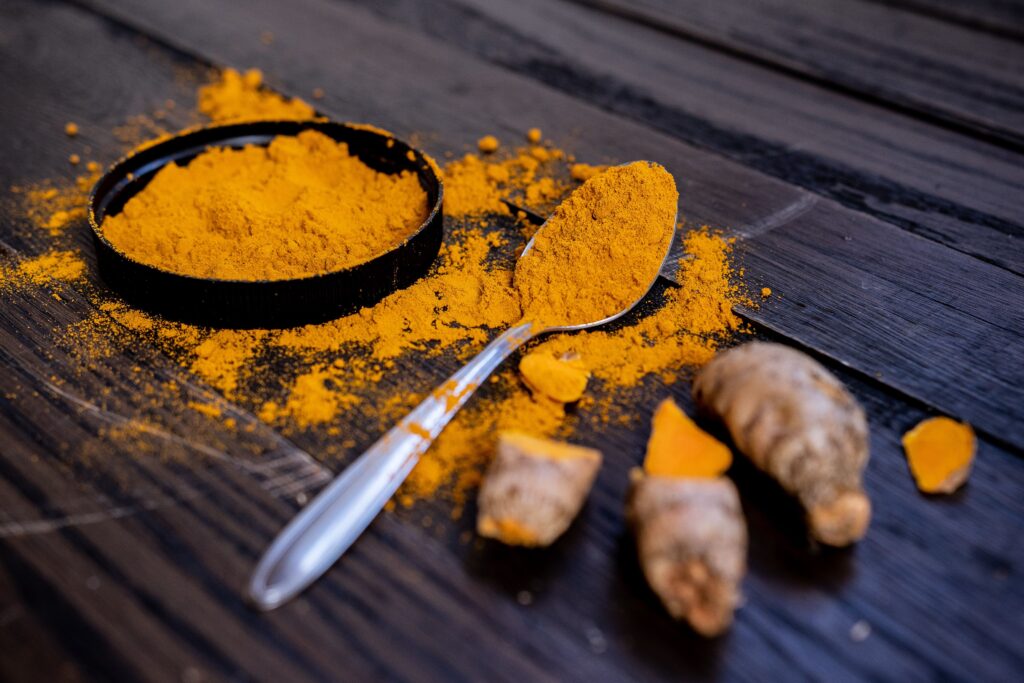
You’ve seen both words on the labels, often on the same bottle, sometimes used as if they mean the same thing. Turmeric. Curcumin. If you’ve stood in the aisle wondering whether you’re supposed to buy one, the other, or both — and whether the difference is real or just marketing — you’re asking exactly the right question. Because the difference is real, and it quietly explains why so many women try turmeric for their aches, feel nothing, and conclude it simply doesn’t work for them.
It usually did work. You were just taking the wrong part of it.
Turmeric is the spice. Curcumin is the active part.
Here’s the whole thing in one sentence: turmeric is the golden-yellow root you cook with, and curcumin is the specific compound inside it that does most of the anti-inflammatory work the research gets excited about. Turmeric is the orchard; curcumin is the fruit. When a study shows turmeric helping with joint discomfort or inflammation, it’s almost always curcumin doing the heavy lifting.
And this is where the disappointment comes from: turmeric is only about two to five percent curcumin by weight. A spoonful in your curry, or a capsule of plain turmeric powder, contains only a trace of the thing you actually wanted. Not nothing — but rarely enough to feel.
Why even curcumin often doesn’t reach you
There’s a second twist, and it’s the one most labels won’t tell you. Even when you take curcumin directly, your body absorbs it poorly — it’s fragile in digestion and most of it passes straight through before it can do anything. This is why “I tried turmeric and felt nothing” is one of the most common sentences in the whole supplement world. The problem was almost never that the science was wrong. It was that the amount reaching your bloodstream was a fraction of what you swallowed.
Which reframes the entire question. It was never really turmeric versus curcumin. It was how much usable curcumin actually gets into you — and that depends far more on the form than on the word on the front of the jar. That’s the part worth understanding properly: why the turmeric most women try doesn’t help much with joint pain — and what does.
So which should you actually buy?
If you love turmeric as a spice, keep cooking with it — it’s a lovely, healthful thing to eat, and paired with a little black pepper and fat it’s better absorbed than plain. Just don’t expect a curry to double as a treatment for real joint pain; the dose isn’t there.
If you’re taking it for something — stiff mornings, aching hands, the low background inflammation of midlife — then the word to look for isn’t “turmeric” at all. It’s a concentrated, well-absorbed form of curcumin, because that’s the only version that reliably arrives in a dose your body can use. A properly made curcumin is a genuinely different experience from the turmeric capsule that quietly let you down.
Want to read the research yourself?
- Turmeric, curcumin, and what the evidence actually shows — U.S. National Center for Complementary and Integrative Health
- Curcumin’s poor bioavailability — and the forms that improve it — Foods review (2017)
There’s real relief in finally understanding it: you weren’t imagining that turmeric did nothing, and you weren’t doing it wrong. You were simply handed the orchard when what you needed was the fruit — concentrated, and in a form that actually reaches you.
Aching joints rarely travel alone in midlife — they arrive with the fatigue and stiffness of a body whose inflammation is quietly rising. The free Energy Audit helps you see the fuller pattern, so you treat the cause instead of chasing one symptom with the wrong jar.