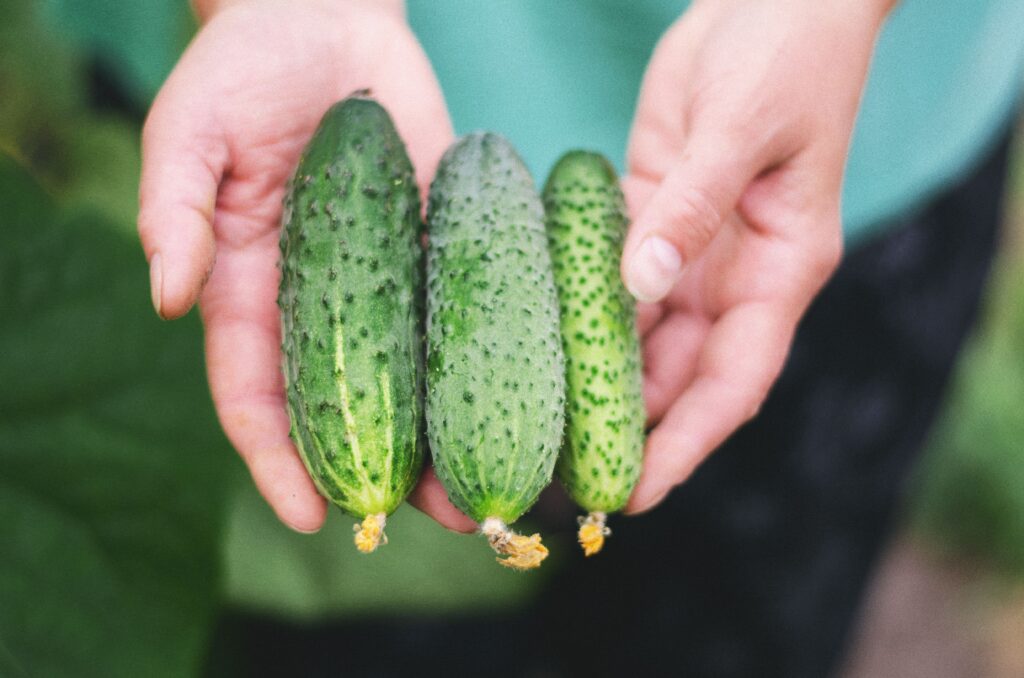
Of all the things you might expect to see in a joint supplement, cucumber probably isn’t one of them. It sounds like a wellness joke — the vegetable that’s mostly water, the thing you put on your eyes, somehow good for your knees? It’s the kind of claim that makes you roll your eyes and scroll on. So it’s genuinely surprising that there’s real research behind it — and even more useful to know exactly where that research stops.
Here’s the honest version, because the honest version is the only one worth your time.
What the research actually looked at
The studies aren’t about the cucumber in your salad. They’re about a concentrated extract of a specific cucumber, standardised for particular compounds and given in a measured dose — a world away from slicing one over dinner. In small trials, that concentrated extract compared surprisingly well to standard joint ingredients for easing everyday joint discomfort and stiffness, at a low dose and with few side effects. That’s the real, and genuinely interesting, finding.
So the eye-roll is half right and half wrong. The vegetable itself won’t do anything for your knees. A concentrated, standardised extract of it is a different substance entirely — and that one has earned a second look.
Why a salad won’t do it (the part nobody says)
This is the distinction that separates honest information from wellness theatre. The active compounds in these studies are present in ordinary cucumber only in traces — you could eat them by the bowlful and never approach the amounts that were tested. It’s the same story as turmeric: the food is lovely, the concentrated form is the one the research is actually about. Anyone selling you “eat more cucumber for your joints” is either confused or hoping you are.
Knowing that saves you both false hope and wasted grocery money — and it’s exactly the kind of detail that tells you whether a source is being straight with you.
Where cucumber extract fits in
On its own, a single ingredient — cucumber extract, glucosamine, boswellia, any of them — is rarely the whole answer for midlife joints, because the stiffness of these years has more than one cause at once: less cushioning, more inflammation, slower repair. This is why the more considered joint formulas combine a few well-chosen ingredients rather than betting everything on one. Cucumber extract is an interesting, well-tolerated piece of that picture — not a miracle, and not nothing. If you want to see how it fits alongside the other pieces that actually matter, that’s laid out here: what genuinely helps the chronic joint stiffness of midlife, ingredient by ingredient.
And if your joint discomfort is driven more by inflammation than by wear, that’s a different lever worth understanding on its own terms: the concentrated-curcumin approach to inflammatory joint pain.
Want to read the research yourself?
- A concentrated cucumber extract vs standard ingredients for joint comfort — randomised trial
- What the evidence shows on supplements for joint pain — U.S. National Center for Complementary and Integrative Health
It’s a small, satisfying thing to have the real story: not “cucumber is a miracle,” not “it’s all nonsense,” but the accurate middle — a surprising ingredient with genuine research behind it, in a form your salad drawer was never going to provide. That’s the difference between being sold to and being informed.
Aching joints in midlife rarely travel alone — the stiffness, the fatigue, the sense of a body changing faster than you’d like. The free Energy Audit helps you see the pattern underneath, so the pieces you choose are part of a plan, not a shot in the dark.