You got dressed this morning and everything sat right. Then somewhere around three in the afternoon the waistband starts to dig in, there’s a tightness under your ribs that wasn’t there at lunch, and you catch your reflection and think: where did that come from? You didn’t eat anything unusual. You didn’t do anything differently at all.
That’s the part that gets to you, isn’t it. Not the discomfort so much as the randomness — the sense that your own body has started making decisions without telling you. The same lunch that was fine on Tuesday leaves you bloated and buttoned-uncomfortable on Thursday, and nobody warned you this was coming.
Why it feels so random
Here’s the quiet truth underneath it: the bloat usually isn’t more food. It’s food moving too slowly. When digestion slows down — and after midlife it naturally does, unevenly, some days more than others — food sits longer than it should. Sitting food ferments. Fermenting food makes gas. Gas is the pressure you feel by mid-afternoon.
Which explains the thing that’s been driving you a little mad: why the exact same meal is fine one day and not the next. It was never really about the meal. It’s about the pace your gut is keeping that day — and that pace has changed.
What ginger actually does to a bloated gut
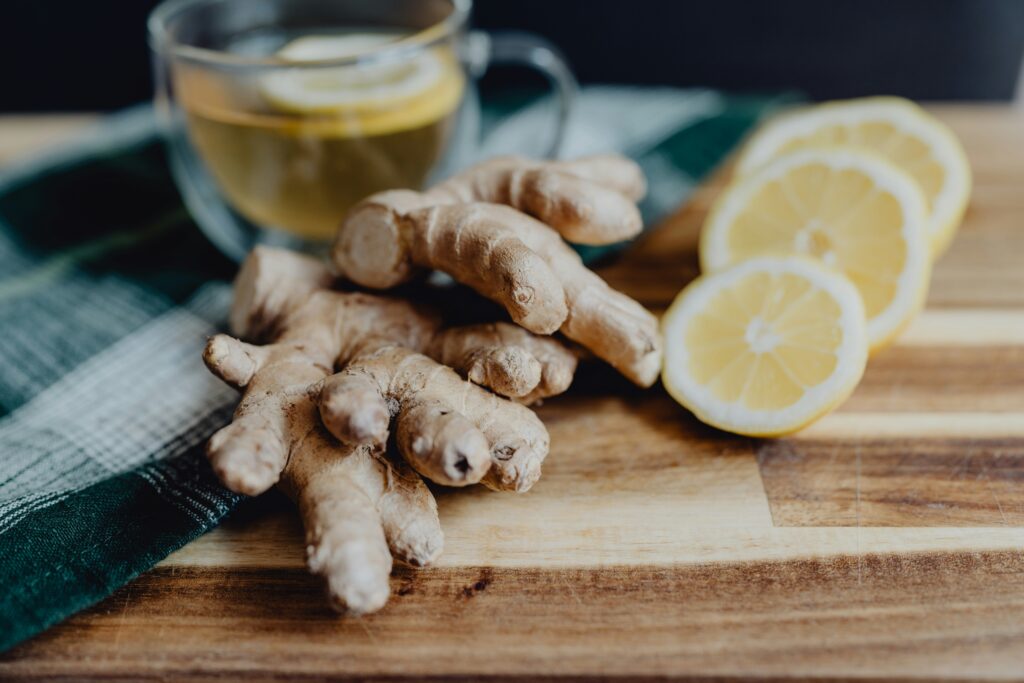
This is where an ordinary knob of ginger earns its place on the counter. Its active compounds — the things that give it that warm bite — gently prompt the gut to contract and move things along. In plain terms: ginger helps a slow stomach empty a little faster, so there’s less food sitting, fermenting, and pressing outward. Less sitting means less gas. Less gas means the waistband that gives you your afternoon back instead of quietly stealing it.
It’s not dramatic and it doesn’t pretend to be. It’s a nudge — but a nudge in exactly the direction the bloat needs.
When to reach for it
The simplest way is the oldest: a few slices of fresh ginger steeped in hot water, sipped with or just after the meal that tends to sit heavy. Not a supplement routine, not a rule to keep — a warm mug next to a lunch you were going to eat anyway. If you already keep ginger for cooking, it’s there. If you don’t, it’s the cheapest thing in the produce aisle and it keeps for weeks.
The honest limits — and when it isn’t the answer
Said straight, because you’ve been sold enough miracles: ginger helps the slow-digestion kind of bloat more than the food-sensitivity kind. If your trouble is a specific food your body stopped tolerating, a mug of tea won’t fix that — that’s a different mechanism worth understanding on its own: foods that never bothered you and suddenly do. And ginger isn’t for everyone — if you’re on blood thinners, prone to reflux, or managing gallstones, be cautious and check first.
Most of all: bloating that’s constant, painful, or comes with other changes isn’t a job for tea. It’s a reason to get looked at properly. If the bloat is a daily fixture rather than an occasional afternoon visitor, it’s worth understanding the fuller picture of what might be going on — here’s what’s often actually behind bloating all the time.
Want to read the research yourself?
We’d rather you checked than took it on faith:
- Ginger benefits, including its effect on digestion and nausea — Johns Hopkins Medicine
- Effects of ginger on gastric emptying and motility in healthy humans — European Journal of Gastroenterology & Hepatology (2008)
The next time the waistband turns on you at three o’clock, you won’t be entirely at its mercy. You’ll know what’s likely happening — food moving slow — and you’ll have one warm, ordinary thing to reach for. Not a cure. Just a small piece of the afternoon handed quietly back to you.
When the bloating and the afternoon tiredness show up together — and they often travel as a pair — it usually points to something underneath both. The free Energy Audit walks you through the five patterns of midlife fatigue, so you can find the one that’s actually yours instead of treating each symptom on its own.