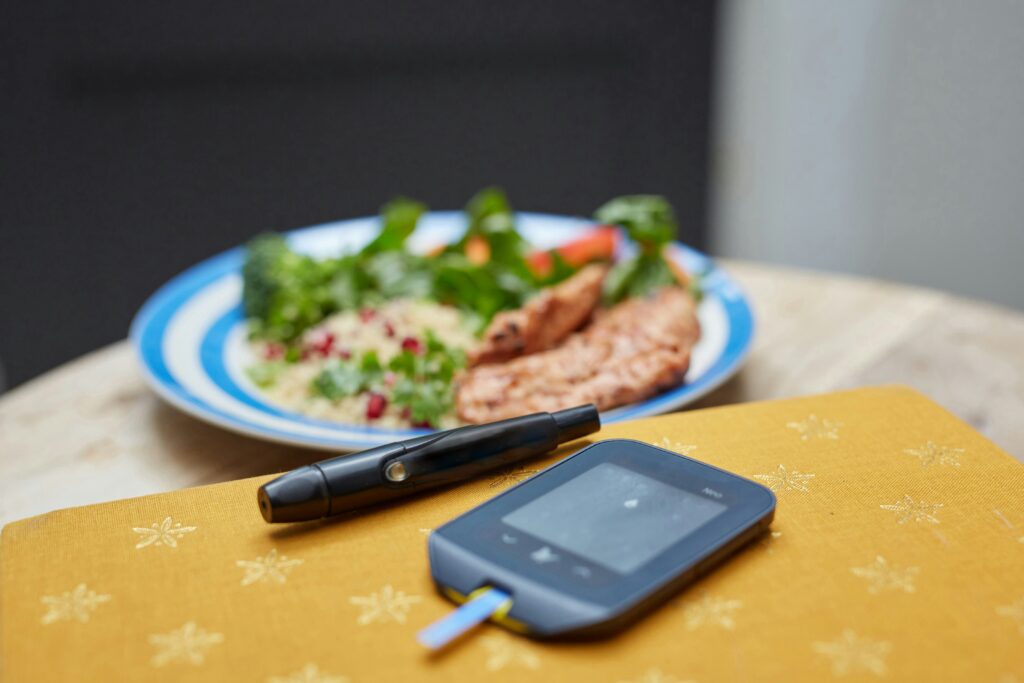
If your fasting glucose came back “normal” but you still crash hard after meals, crave sugar every afternoon, gain weight around your belly, and wake up at 3 AM—you’re experiencing something incredibly common that standard glucose screening doesn’t catch.
The issue isn’t that your doctor missed anything. The issue is that standard diabetes screening only checks one marker: fasting glucose (your blood sugar after not eating for 8-12 hours). And while fasting glucose tells you if you have diabetes right now, it doesn’t show how your body handles sugar after you eat.
This guide breaks down the difference between fasting glucose and post-meal blood sugar responses, shows you exactly what tests reveal insulin resistance early, and gives you the language to have a productive conversation with your doctor about comprehensive metabolic testing.
So if fasting glucose only shows part of the picture, what does it miss? A lot — and that’s where most women get stuck.
To understand why “normal” fasting glucose doesn’t mean you’re fine, we need to look at what standard testing actually measures—and what it completely misses.
Why “Normal” Fasting Glucose Doesn’t Always Mean Your Blood Sugar Is Fine
When your doctor says “your glucose is normal,” they’re looking at your fasting glucose—your blood sugar level after you haven’t eaten for 8-12 hours.
Fasting Glucose (Simple Explanation)
- Your blood sugar after fasting overnight
- Shows whether you have diabetes right now
- Normal: <100mg/dL
- Prediabetes: 100–125 mg/dL
- Diabetes: ≥126 mg/dL
But fasting glucose only tells part of the story. It doesn’t show:
- How high your blood sugar spikes after you eat (post‑meal blood sugar (post‑prandial glucose))
- How much insulin your pancreas is producing (fasting insulin)
- Whether your cells are responding to insulin properly (insulin resistance)
These are the early warning signs of insulin resistance — and they show up years before fasting glucose changes.
Once you see how fasting glucose fits into the bigger picture, the next question becomes: what’s happening behind the scenes?
Here’s how insulin resistance develops (years before diabetes):
Stage 1: Early Insulin Resistance
- Your cells start ignoring insulin →
- Your pancreas makes MORE insulin to compensate →
- Fasting insulin is high, but fasting glucose still normal
Stage 2: Post‑Meal Spikes + Crashes
- Your pancreas can’t keep up →
- Blood sugar stays elevated longer after meals →
- You crash 1–2 hours later (Reactive hypoglycemia)
Stage 3: Fasting Glucose Finally Rises
Now you’re labeled “prediabetic” or diabetic — but this is the final stage
Most women are stuck in Stage 1 or 2 — dealing with energy crashes, cravings, belly weight gain, and 3 AM wake‑ups — yet told they’re “fine” because fasting glucose is the only thing tested. The American Diabetes Association confirms that insulin resistance can develop years before glucose levels rise, making early detection through insulin testing critical for prevention.
Your fasting glucose can be perfect while your insulin is sky-high (meaning you’re already insulin resistant). This is why you can have:
- Normal fasting glucose (<100 mg/dL)
- High fasting insulin (>10 µIU/mL)
- And all the symptoms of insulin resistance
The good news? You don’t have to guess which stage you’re in. A complete blood sugar panel shows you exactly where things stand.
Now that you understand why fasting glucose alone isn’t enough, here’s the complete blood sugar panel that shows what’s happening at all three stages of insulin resistance.
The Complete Blood Sugar Panel (What to Request)
Most routine screenings only check fasting glucose. That tells you whether you have diabetes today, but it doesn’t show whether you’re developing insulin resistance — the stage where symptoms begin.
Standard screening runs fasting glucose only—it checks if you have diabetes today, but not if you’re developing insulin resistance.
When you talk to your doctor, these are the tests that give you the full picture, showing your metabolic health at all three stages:
1. Fasting Glucose
- Medical term: Fasting blood glucose (FBG) or fasting plasma glucose (FPG)
- What it measures: Your blood sugar after 8–12 hours without food
- Normal: <100 mg/dL
- Optimal: 70-85 mg/dL (not just <100)
- What it tells you: Whether you have diabetes right now (Stage 3)
2. Fasting Insulin
- Medical term: Fasting insulin or fasting serum insulin
- What it measures: How much insulin your pancreas is producing when fasting
- “Normal” range: 2-20 µIU/mL (varies by lab)
- Optimal range: <10 µIU/mL (ideally 2-7)
- What it tells you: This is the most important test—High fasting insulin shows insulin resistance years before glucose rises (Stage 1).
3. HbA1c (Hemoglobin A1c)
- Medical term: HbA1c or glycated hemoglobin
- Simplified: Your average blood sugar over the past 3 months. (The National Institute of Diabetes and Digestive and Kidney Diseases considers HbA1c one of the most reliable indicators of long-term glucose control)
- Normal: <5.7%
- Prediabetes: 5.7-6.4%
- Diabetes: ≥6.5%
- Optimal: <5.4%
- What it tells you: Shows long‑term blood sugar patterns (Stage 2–3) (catches Stage 2-3)
4. HOMA-IR (Homeostatic Model Assessment of Insulin Resistance)
- Medical term: HOMA-IR score
- Simplified: Calculation using your fasting glucose + fasting insulin to assess insulin resistance
- Formula: (Fasting glucose × Fasting insulin) ÷ 405
- Normal: <2.0
- Insulin resistant: >2.0
- Severe: >5.0
- What it tells you: Direct measure of insulin resistance (Stage 1-2)
5. Oral Glucose Tolerance Test (OGTT) – Optional
- Medical term: OGTT or 2-hour glucose tolerance test
- What it measures: How your blood sugar responds to a glucose drink over 2 hours
- When it’s useful:
- If fasting tests are borderline
- ou suspect reactive hypoglycemia (crash after eating)
- What it tells you: Shows real‑time spikes and crashes (post‑meal response)
Before you ask for these tests, it helps to understand why they’re not standard.
The Insulin Controversy: Why Your Doctor Might Not Test It
This part can feel frustrating.

Most doctors don’t routinely test fasting insulin.
Why not?
Standard diabetes screening guidelines (from organizations like the American Diabetes Association) focus on glucose, not insulin. The guidelines typically say: “Screen with fasting glucose and HbA1c.”
Fasting insulin isn’t part of standard protocols—not because it’s not useful, but because the focus has historically been on diagnosing diabetes (which shows up in glucose), not catching insulin resistance early (which shows up in insulin).
The problem is that glucose rises last.
By the time fasting glucose is high enough to diagnose prediabetes, insulin resistance has often been present for 5–10 years.
The opportunity is that fasting insulin catches the problem at Stage 1 — when it’s most reversible.
This is why functional medicine doctors and metabolic health specialists test insulin routinely—but many primary care doctors don’t.
Your doctor isn’t being difficult. They’re following standard guidelines. Your job is to help them understand why you’re asking for insulin testing and why it matters for your specific symptoms.
This is where your approach matters. A few simple phrases can make the difference between a ‘no’ and a ‘yes.’
Understanding why doctors don’t test insulin is one thing. Knowing how to actually get them on board with testing it—without creating conflict—is another.
How to Talk to Your Doctor (Collaborative Approach)
Most doctors will run insulin testing if you explain why you’re asking and connect it to your specific symptoms.
Instead of: “Why didn’t you check my insulin?”

Try this:
“Thank you for running my fasting glucose and HbA1c—I appreciate you screening for diabetes. Both came back normal, which is reassuring.
But I’m still experiencing symptoms that are really affecting my life: I crash hard 1-2 hours after eating, I crave sugar every afternoon, I’m gaining weight around my belly even though i’m eating less, and I’m waking up between 2-4 AM.
I’ve been reading that fasting insulin can reveal insulin resistance years before glucose rises, and that insulin resistance causes exactly these symptoms. Would you be comfortable adding fasting insulin to my next lab draw so we can see if insulin resistance is developing even though my glucose is normal?
If insulin comes back normal too, I’ll feel confident ruling out blood sugar issues and we can investigate other causes together.”
Why this works:
- Acknowledges the initial testing
- Lists specific, measurable symptoms (not just “I’m tired”)
- Shows you understand the medical reasoning
- Explains why insulin matters (catches it early)
- Frames it as prevention, not challenge
- Respects partnership
If your doctor says insulin testing isn’t necessary:
“I understand it’s not part of standard screening. Would you be comfortable ordering it anyway, given how much these symptoms are affecting my quality of life? I’m willing to pay out‑of‑pocket if insurance doesn’t cover it. I’d really value your interpretation of the results — I want to catch any metabolic issues early.”
Alternative: “If you’re not comfortable ordering it, could you recommend a lab where I can order it directly? I’d like to bring the results back to you to so we can review together.”
Once you have your complete blood sugar panel results in hand, here’s how to interpret what you’re seeing—and what each pattern means for your next steps.
What Your Results Mean (And What to Do Next)
Scenario 1: Fasting glucose normal (<100), but fasting insulin Above 10 µIU/mL
If you feel exhausted, crave sugar, or gain belly weight even though your labs look ‘normal,’ this is often the pattern behind it
What this means:
This is early insulin resistance (Stage 1). Your cells are starting to ignore insulin, so your pancreas produces more to compensate. Glucose still looks normal, but the underlying issue has already begun.
What causes this:
- Sedentary lifestyle: When muscles aren’t used regularly, they become less responsive to insulin.
- Chronic stress: Stress hormones raise blood sugar and make cells less sensitive to insulin.
- Poor sleep: Even one night of poor sleep can increase insulin resistance the next day.
- Genetics: Some women are genetically more prone to insulin resistance, especially if it runs in the family.
- PCOS: One of the most common hormonal conditions linked to high insulin levels.
What helps:
Food changes (most important), daily movement, stress reduction, and sometimes supplements like berberine.
Good news:
This is the most reversible stage. Catch it here and you can prevent diabetes entirely.
Scenario 2: Fasting glucose 100-125 mg/dL (prediabetes) or HbA1c 5.7- 6.4%
If your numbers fall here, your body is signaling that it’s struggling to keep up.
What this means:
This is prediabetes (Stage 2–3). Your body has moved beyond early insulin resistance and is now struggling to regulate glucose.
What helps:
A more aggressive approach — food changes, movement, weight loss if needed, and sometimes medication like metformin.
Important:
Prediabetes is still reversible with consistent changes
If you’ve been told you’re ‘borderline,’ this is your window to turn things around.
Scenario 3: HOMA-IR score Above 2.0
This score helps you see the full picture — not just glucose, but how hard your body is working behind the scenes.
What this means:
Confirmed insulin resistance
Calculation example:
- Fasting glucose: 95 mg/dL
- Fasting insulin: 15 µIU/mL
- HOMA-IR: (95 × 15) ÷ 405 = 3.5 (insulin resistant)
What helps:
The same approach as Scenario 1 — diet first, supported by movement and stress management.
If you’ve been feeling ‘off’ for years, this score often explains why.
Scenario 4: Everything is truly normal
If all your numbers fall in the optimal range, that’s great news — and it also means your symptoms likely have another cause.
Optimal ranges:
- Glucose: <85 mg/dL
- Insulin: <7 µIU/mL
- HbA1c: <5.4%
What this means:
Blood sugar isn’t your primary issue
Next steps: Start with the Energy Detective Guide to identify your pattern, then explore our guides on thyroid testing or iron testing.
If your labs look perfect but you still feel exhausted, you’re not imagining it — it just means the root cause lies elsewhere.
Scenario 5: Normal fasting tests, But you Crash Hard After Eating
This is one of the most common — and most confusing — patterns women experience.
What this means:
This is reactive hypoglycemia — your blood sugar spikes after meals, then crashes low because your body releases too much insulin. Mayo Clinic
notes that reactive hypoglycemia often occurs in people developing insulin resistance, even when fasting tests appear normal.
What helps:
Protein at every meal, no “naked carbs,” walk after meals, possibly chromium supplementation
Optional testing:
An Oral glucose tolerance test (OGTT) to see real-time response, or continuous glucose monitor (CGM) to track patterns show real‑time spikes and crashes.
If you feel great after eating but crash an hour later, this is often the reason.
What Actually Helps (Diet Is Primary—Not Negotiable)
Once you understand what your numbers mean, the next step is knowing what actually moves the needle. And here’s the truth most women never hear: you can’t out‑supplement a blood sugar pattern that’s driven by food.
Food is the foundation. Everything else is supportive.

The Non-Negotiables (Start Here)
1. Protein at every meal (especially breakfast)
The science: Protein slows down how quickly sugar enters your bloodstream. This keeps your energy steady for 6–8 hours and prevents the big insulin spikes that lead to crashes.
The rule: 30g protein within 1 hour of waking
What protein does (simple):
- Helps slow digestion
- Keeps blood sugar steady
- Reduces cravings
- Supports muscle and metabolism
What 30g looks like:
- 3 eggs
- 1 cup Greek yogurt + 2 tbsp seeds
- A protein shake
- Leftover chicken or fish (yes, even for breakfast)
Easy breakfast options:
- 3 eggs (any style) + avocado
- Greek yogurt (1 cup) + hemp seeds (2 tbsp) + berries
- Protein smoothie: 1 scoop powder + ½ avocado + spinach + berries
- Leftovers from last night (yes, chicken and vegetables for breakfast)
Full 3-day protocol: Pattern 1: The 3 PM Wall in your Energy Detective Guide
2. Never eat “naked carbs”
This one shift alone changes everything for women who crash after meals.
What “naked carbs” means:
Carbs eaten alone — without protein or fat — hit your bloodstream fast and cause a spike → crash cycle.
Instead of this: Toast with jam (naked carbs)
Do this: Toast with almond butter + scrambled eggs (protein + fat slows absorption)
Instead of this: Fruit smoothie (naked carbs—even though fruit is “healthy”)
Do this: Smoothie with protein powder + ½ avocado (slows glucose absorption)
Instead of this: Rice bowl (naked carbs)
Do this: Rice bowl with grilled chicken, avocado, vegetables (balanced meal)
If you feel great right after eating but crash an hour later, naked carbs are usually the reason.
3. Skip all liquid sugar (non-negotiable)
Why:
Liquid sugar hits your bloodstream faster than anything else because there’s no fiber to slow it down.
Cut these completely:
- Juice (yes, even “healthy” fresh-pressed juice)
- Soda (regular, not diet)
- Sweet tea
- Sweetened coffee drinks (lattes with syrup)
- Sports drinks
- Flavored water with sugar
Choose instead:
Water, black coffee, unsweetened tea, sparkling water with lemon.
If you get a mid‑morning or mid‑afternoon crash, liquid sugar is often the hidden culprit.
4. Walk 10 minutes after meals
The science: Movement helps your muscles pull sugar out of your bloodstream — instead of storing it as fat , lowering post‑meal spikes by 20–30%.
How to do it:
Walk for 10 minutes at any pace right after eating — especially lunch and dinner.
If you’ve ever felt sleepy after a meal, a short walk can change that almost instantly.
Why You Wake Up at 3 AM (The Blood Sugar-Cortisol Connection)
This is one of the most common patterns women describe — and it has a surprisingly simple explanation. If you regularly wake up between 2–4 AM, your blood sugar may be dipping too low overnight.

Here’s what happens:
Evening: You eat dinner (maybe with dessert or wine)
↓
2-3 hours later: Blood sugar spikes from that meal
↓
4-6 hours later (middle of night): Blood sugar crashes low
↓
Your body panics: Releases cortisol (stress hormone) to bring blood sugar back up
↓
Cortisol is an “alert” hormone: It wakes you up
Cortisol
- Stress hormone made by adrenal glands
- Raises blood sugar when it drops too low
- Also wakes you up (it’s an alerting hormone)
The fix:
- Eat protein with dinner (stabilizes overnight blood sugar)
- Skip late-night carbs, alcohol, and dessert
- Consider small protein snack before bed (Greek yogurt, hard-boiled egg, handful of nuts)
This alone solves 3 AM wake-ups for many women. For more on sleep disruption and blood sugar patterns, see our complete guide to how blood sugar affects sleep.
Supporting Blood Sugar Stability (While You Fix Diet)
Food is the foundation, but these tools can support the process—they don’t replace food changes.
Studies show Moringa leaf powder can support healthy fasting glucose and insulin sensitivity.
Anti-Inflammatory Support
Chronic inflammation worsens insulin resistance. Your cells can’t respond to insulin properly when they’re inflamed.
Moringa is one of the most researched anti-inflammatory compounds:
- Reduces systemic inflammation
- Contains compounds that support healthy blood sugar levels
- Provides sustained energy without blood sugar spikes
- Antioxidant protection for cells
The research: Studies show Moringa leaf powder reduces fasting glucose and improves insulin sensitivity in people with prediabetes.
As your blood sugar stabilizes, reducing inflammation becomes the next lever. That’s where Moringa shines. It’s been studied for its ability to support healthy blood sugar, calm inflammation, and provide steady energy without spikes

Pause here for a moment…
You’ve probably tried cutting carbs, eating “clean,” maybe even fasting—but the crashes keep happening. The afternoon cravings won’t quit. And your body keeps storing fat around your middle despite eating less.
Here’s what often gets missed: chronic inflammation makes insulin resistance worse. When your cells are inflamed, they can’t respond to insulin properly—which means glucose stays elevated longer after meals, triggering more insulin, creating more inflammation. It’s a vicious cycle.
What Moringa Magic provides:
Moringa leaf contains concentrated anti-inflammatory compounds—quercetin, chlorogenic acid, isothiocyanates—that research shows can support healthy fasting glucose and improve insulin sensitivity in people with prediabetes.
It’s 100% pure moringa leaf in capsule form—nothing added, nothing removed. Not extract (which strips away beneficial compounds). Not powder you need to mix into drinks daily (which is why 90% of people quit by week three). Just whole moringa leaf in convenient capsules you can take consistently.
Why the capsule form matters for blood sugar patterns:
You need consistency over weeks—not intense effort for a few days then giving up. Capsules remove the preparation barrier. You take them daily like a vitamin, your inflammation gradually settles, and your insulin sensitivity slowly improves.
Research suggests benefits become noticeable around 4-6 weeks with consistent daily use. That’s why the 60-day money-back guarantee matters—it exceeds the timeline needed to evaluate whether reducing inflammation helps your specific blood sugar pattern.
Important: Moringa isn’t a substitute for food changes.
If you’re still eating naked carbs and skipping protein at breakfast, no supplement will fix that. But if you’re implementing the diet strategies and want additional anti-inflammatory support while your body relearns insulin sensitivity—this is a research-backed option.
With 13,176+ customer reviews and a 60-day guarantee, you can test whether anti-inflammatory support addresses your specific pattern.
If you’re curious about how it works, these articles break it down in simple, science‑backed language: 7 Moringa Benefits: Science-Backed Energy & Wellness and 7 Anti-Inflammatory Foods That Fight Fatigue
Frequently Asked Questions
These are the questions women ask most often when they start this process.
Yes. This is extremely common. Your insulin can be high (indicating resistance) for 5-10 years before your glucose rises. This is why testing fasting insulin is so important—it catches the problem early when it’s most reversible.
Insulin resistance = Your cells ignore insulin (Stage 1-2) → fasting insulin is high, glucose still normal
Prediabetes = Your pancreas can’t keep up anymore (Stage 2-3) → glucose starts rising
Insulin resistance comes first. Prediabetes is the next stage. Both are reversible with lifestyle changes.
With consistent dietary changes and exercise, most people see improvement in insulin sensitivity within 4-8 weeks. Fasting insulin can drop significantly in 3 months. But this requires actual consistency—protein at every meal, no liquid sugar, daily movement.
Maybe, but not until you’ve stabilized your blood sugar first. If you’re currently crashing after meals, skipping meals will make it worse. Fix the basics first (protein at every meal, no naked carbs, walk after meals), THEN consider time-restricted eating once you’re stable.
Yes. Chronic stress raises cortisol, which raises blood sugar and worsens insulin resistance. This is why many women with Pattern 2 (Tired But Wired—high cortisol) also have Pattern 1 (blood sugar issues)—the patterns overlap. Address both simultaneously.
They can help insulin resistance, but they’re not necessary for everyone. The most important changes: protein at every meal, no liquid sugar, no naked carbs, walk after meals. Some women do well adding low-carb on top of this. Others don’t need to go that far. Start with the basics, track how you feel, adjust from there.
Your Action Plan
Here’s how to put everything into motion without feeling overwhelmed.
This week:
- Start with protein at breakfast (30g within 1 hour of waking)
- Walk 10 minutes after lunch and dinner
- Cut all liquid sugar completely
At your doctor’s appointment:
- Bring this guide
- Request: Fasting glucose, fasting insulin, HbA1c
- Ask for printed results with reference ranges (not just “normal”)
After you get results:
- Fasting insulin >10 or HOMA-IR >2: Implement full blood sugar protocol + consider Moringa for inflammation
- HbA1c 5.7-6.4%: Aggressive lifestyle intervention + close monitoring
- Everything optimal: Return to Energy Detective Guide and test Pattern 3 (thyroid) or Pattern 4 (iron)
Long-term (if insulin resistant):
- Retest fasting insulin and HbA1c every 3 months
- Track how you FEEL (energy, cravings, sleep), not just numbers
- Consider continuous glucose monitor (CGM) for 2-4 weeks to see your real-time patterns
What If Blood Sugar Isn’t Your Whole Story?
You’ve done the work: gotten your complete blood sugar panel, implemented the diet changes, and maybe even started anti-inflammatory support. But what if your fasting insulin comes back optimal and you’re still exhausted?
This happens more often than you’d think. Many women assume fatigue must be blood sugar-related, get comprehensive testing, discover blood sugar is only part of the picture—or not the issue at all.
The most common overlapping or alternative causes:
- Thyroid conversion problems (TSH normal but Free T3 low)
- Iron deficiency (hemoglobin normal but ferritin depleted)
- Chronic inflammation (affecting energy at cellular level)
- Sleep architecture disruption (beyond the 3 AM wake-ups)
- Stress hormone dysregulation (cortisol patterns overlap with blood sugar issues)
Blood sugar problems rarely exist in isolation. They often overlap with other patterns— which is why some women fix diet, stabilize glucose, and still don’t feel great.
The Energy Detective Starter Kit walks you through systematically identifying ALL your energy drain patterns. It’s a free guide that helps you recognize which of the 7 common patterns are affecting you—blood sugar might be one of three issues working together.
If your blood sugar panel comes back optimal but you’re still struggling—or if you’ve fixed blood sugar but something still feels off—this is your next step.
Medical Disclaimer: This article is for educational purposes only and isn’t a substitute for medical advice. Always speak with your healthcare provider before starting any new supplement, especially if you have a medical condition or take prescription medications. Supplements are not intended to diagnose, treat, cure, or prevent disease.
Affiliate Disclosure: This article contains affiliate links to products that meet our research standards. We earn a small commission on purchases at no cost to you, which supports our ongoing product testing and content creation. We only recommend products we genuinely believe are worth your time and money.