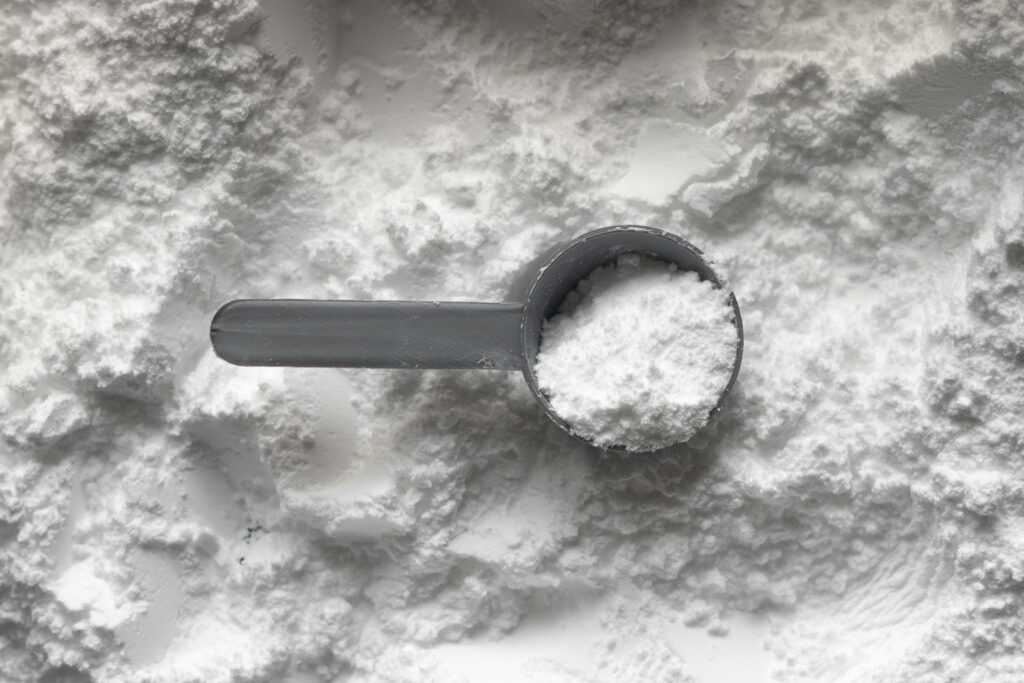
You bought the collagen. You took it more or less every day, for a month, maybe three. And then somewhere in there you quietly stopped — not because you decided it didn’t work, but because you couldn’t tell if it did, and the tub ran out, and you didn’t rush to replace it. If that’s the whole arc of your collagen experience, you’re in good company. It’s the most common collagen story there is.
Here’s what almost no one tells you: the problem often wasn’t collagen. It was that collagen. And there’s a way to tell the difference standing at your own kitchen counter, in about ten seconds, before you spend another cent.
The 10-second kitchen test
Open the tub and smell it. Then stir a scoop into a glass of cool water and watch what it does.
Good collagen is almost nothing to the senses. It has next to no smell, and it dissolves cleanly, without a greasy film or a stubborn raft of clumps. If instead it hits you with a strong odour — beef jerky, fish, something faintly like a wet dog — or if it refuses to dissolve and sits in lumps on the surface, that’s not a quirk of the batch. It’s a signal about how it was made and how well your body will be able to use it. A powder that smells strongly and dissolves badly is telling you something before you’ve swallowed a single dose.
It feels almost too simple to be diagnostic. But the reasons behind it are real, and they’re the same reasons that first tub quietly disappointed you.
What the smell and the clumps are actually telling you
Two things separate a collagen worth taking from one that mostly wastes your money, and the kitchen test hints at both.
The first is how well it’s broken down. Collagen has to be hydrolysed — cut into small fragments called peptides — for your body to absorb it. Poorly processed collagen absorbs badly, and it tends to be the clumpy, hard-to-dissolve kind. What won’t dissolve in your glass doesn’t dissolve easily in you either. A clean, near-instant mix is a rough but honest sign the work was done properly.
The second is how many kinds of collagen it contains. This is the detail most tubs quietly skip. Your body doesn’t make one collagen — it makes several, each doing a different job. Types I and III are the skin, hair and nail collagens. Type II lives in your cartilage and joints. Others support your bones and the linings that hold you together. Most products on the shelf give you just one or two types, usually the skin ones, and then wonder why the joint and structural benefits never show up. If you’re taking collagen for everything that softens and stiffens in midlife — not just your face — a single-type powder was always going to leave gaps.
What a collagen built to pass the test looks like
Once you know what you’re looking for, the shortlist gets short fast. You want collagen that’s properly hydrolysed — flavourless, near-odourless, dissolving clean — and that covers more than one type, so the skin, the joints and the structure all get the raw material, not just the mirror.
This is the gap Advanced Collagen Plus was built to close. It brings together five collagen types from four sources — bovine, chicken, marine and eggshell membrane — so you’re feeding your skin, your joints and your bones the specific building material each of them uses, not just the one type most powders stop at. It’s designed to be the flavourless, clean-dissolving kind that passes the very test above — the opposite of the smelly, clumpy tub that quietly ended up at the back of the cupboard.
Who this won’t help
Said straight, because that’s the whole point of this brand: a better collagen is not a magic one. If you’re eating well, pairing your protein with vitamin C, and your skin and joints are genuinely fine, you may not need a supplement at all — food is doing its job, and that’s the best outcome there is. If your issue is something collagen simply doesn’t address — a thyroid problem, a specific joint injury, a skin condition that needs a doctor — no powder will stand in for the care you actually need. And if you take collagen for two weeks and expect a different face, you’ll be disappointed; this is slow, structural work measured in months, not days.
What a good collagen can do is stop you wasting money and hope on a poor one, and give your body a real, absorbable supply of the material it’s losing faster every year. That’s a fair, honest promise — and it’s a very different thing from the tub that failed you.
Before you buy another tub
Do the test on whatever you have now. Smell it, stir it, watch it. If it fails, you finally know why the last one didn’t seem to work — and what to look for instead. If you’d rather not run the experiment on your own dime again, start with one built to pass it and to cover more than your reflection.
Want to read the research yourself?
- How hydrolysed collagen peptides are absorbed — and why processing matters — Nutrients review (2019)
- Collagen supplementation and skin elasticity, hydration and joint comfort — review of controlled trials
Stop feeding your skin, joints and bones a collagen your body can barely use. Give them the full range of building material they’ve been quietly running short of — and see what a collagen worth taking actually feels like.
Disclosure: This article contains affiliate links. If you buy through them, Serenis Naturals may earn a commission at no extra cost to you. We only point to products we’d be comfortable standing behind — and we’ve told you above exactly who this one won’t help.